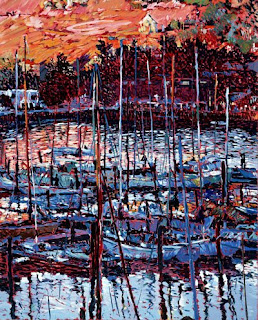
Marco Sassone will be a part of the group show SummerSet
at David Findlay Jr. Fine Art from July 1 to August 20, 2010 David Findlay Jr. Fine Art
David Findlay Jr. Fine Art David Findlay Jr. Fine Art
 The artist produces a small number of original works on ceramic. While ceramic art is traditionally decorative and descriptive, Sassone strives to paint as he does on canvas. After a period of experimentation in which he mastered the technical aspects of the medium, he felt the same urge that had given life to his paintings, with the added appeal of the three dimensional quality of the bisque.


 Telegraph Hill, 1982©Marco Sassone
Available directly from the studio in limited edition, and printed on archival paper, each Giclée print is numbered and signed by the artist.

Courtesan Dressing Her Hair (ca. 1900)
The following letter was published in the January 2007 issue of Art in America
Dear Editors:
Regarding the Letters to the Editor, “Clemente’s Indian Sources” and “Brooks Adams replies” Art in America, Sept 2006, pg 33.
“Someone did give him a catalogue about them once…” well, obviously that is where Francesco Clemente found the images for his paintings.
Vinod Dave did an excellent job uncovering Clemente’s Indian sources; he did what everyone else was unable to do. I am at a loss, however, to understand why the artist did not disclose his working “appropriations” to Brooks Adams. Clemente tells Adams about his working procedures in great detail at his New York Studio, but chooses to omit his Indian sources. The mention of the Self Portrait as Bengali Woman in the feature article, Demon Iconographer, (Art in America, May 2006) where Brooks noted that this work by Clemente was “at the top of his game” is amusing when one considers that the image for this painting was in fact appropriated from the Kalighat school of painting.
Once these interesting sources were discovered by Dave, Clemente still chooses to avoid the subject and elects to tell us, among other things, that “Salman Rushdie never mentions the connection in his Gagosian Gallery catalogue essay.” What does this comment really mean? That Rushdie needed to do research on Clemente’s work to ascertain that the work was authentic? Or that Clemente expects the readers to suspend the use of their reason when viewing the Kalighat paintings? Furthermore, when confronted with these sources, whose images are very well known to Clemente, the artist seems to assume a position of memory failure, some sort of denial that proves to be irritating for the reader.
When one considers the facts of this matter, Brooks Adams, Salman Rushdie and the Gagosian Gallery all failed in making the connection between Clemente’s work and the Indian paintings. We can categorize them as simply ignorant of the existence of these images from the Kalighat school. With regard to the artist however, who admittedly knew of the Kalighat school, his failure to credit them is totally unacceptable.
Marco Sassone

 The image size is 30" x 36"